Provides advanced processing options.
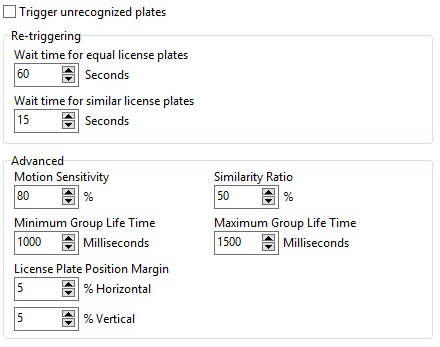
•Triggering unrecognized plates: This option only works for the physical or external sensor. If a license plate is not recognized after the sensor is triggered, the system will generate a record without a license plate.
•Retriggering: Provides options for retriggering control of cards that are recognized multiple times in a short period of time
oWaiting time for re-triggering of identical plates: If the same plate is recognized in less than X seconds (configured) since its last capture, the system will ignore it and will not generate a new record.
oWaiting time for re-triggering similar plates: If a very similar plate is recognized in less than X seconds (configured) since the last capture of the similar plate, the system will ignore it and will not generate a new record, avoiding false positives in the reading.
•Advanced: Advanced processing options.
oMotion Sensitivity: How much movement the system must detect for it to take a reading. The higher this value, the less movement will be required for the trigger.
oSimilarity Ratio: How similar the plate must be (in %) for the system to consider the same reading as possible. For example, when several readings are made in sequence, the system evaluates the similarity between them and if they are within the configured %, it considers it a possible reading error, waiting for the closing time of the similarity group to display the best reading made.
oMinimum Group Lifetime: Every recognized plate will create a temporary group that will contain all recognition records for this plate. Plates with very high similarity (previously configured) will be added to the same group as they may have been the result of an engine reading failure, different plates or those with low similarity will create their own groups. This option will determine the minimum lifetime of the group, that is, when a new plate is recognized, the group will be created and maintained for at least X milliseconds (configured), awaiting new readings in order to group the results into just one record and provide the record with better reading quality as a result. For example, if the LPR server is processing 30 frames per second from this camera, a group with a lifetime of at least 1 second will potentially contain 30 recognition records for the same license plate (1 for each frame if the license plate has been recognized in all frames), so it is possible to determine the best reading to offer the most accurate result. As this is a minimum value for the life of the group, the result will only be displayed after closing the group, that is, if this configured value is too high, you may experience latency in the recognition response, where, for example, a group configured with minimum lifetime of 5 seconds (5,000 milliseconds) will have a latency of at least 5 seconds between the vehicle passing through the image and the response with the reading result. The group will remain open for the specified time even if the system is no longer recognizing the plate in this group and as explained, this will be the minimum response latency time (Not counting the LPR Bridge processing time for integrations with external systems).
oMaximum Group Lifetime: This value determines the maximum time that a group can remain open waiting for new readings from a plate to determine the best reading for the result. While the minimum group time determines the minimum time that the group will be open waiting for readings from a card, the maximum value will be used if the card continues to be read after the minimum time, that is, if you keep a very high maximum value and the plate is no longer present in the image after the minimum time, the group will be closed, however, if after the minimum time the plate still remains in the scene, the group will continue to be open, receiving new records, until the maximum configured time is reached , where the result will be presented regardless of whether the card is still in the scene, therefore, this will be the maximum latency time of the reading response (Not counting the LPR Bridge processing time for integrations with external systems).
•License Plate Position Margin: Determines a border (in %) around the image where if a plate recognized within this border will be discarded from the result. This configuration is necessary to avoid partial plate captures, where part of the plate may still be outside the image.